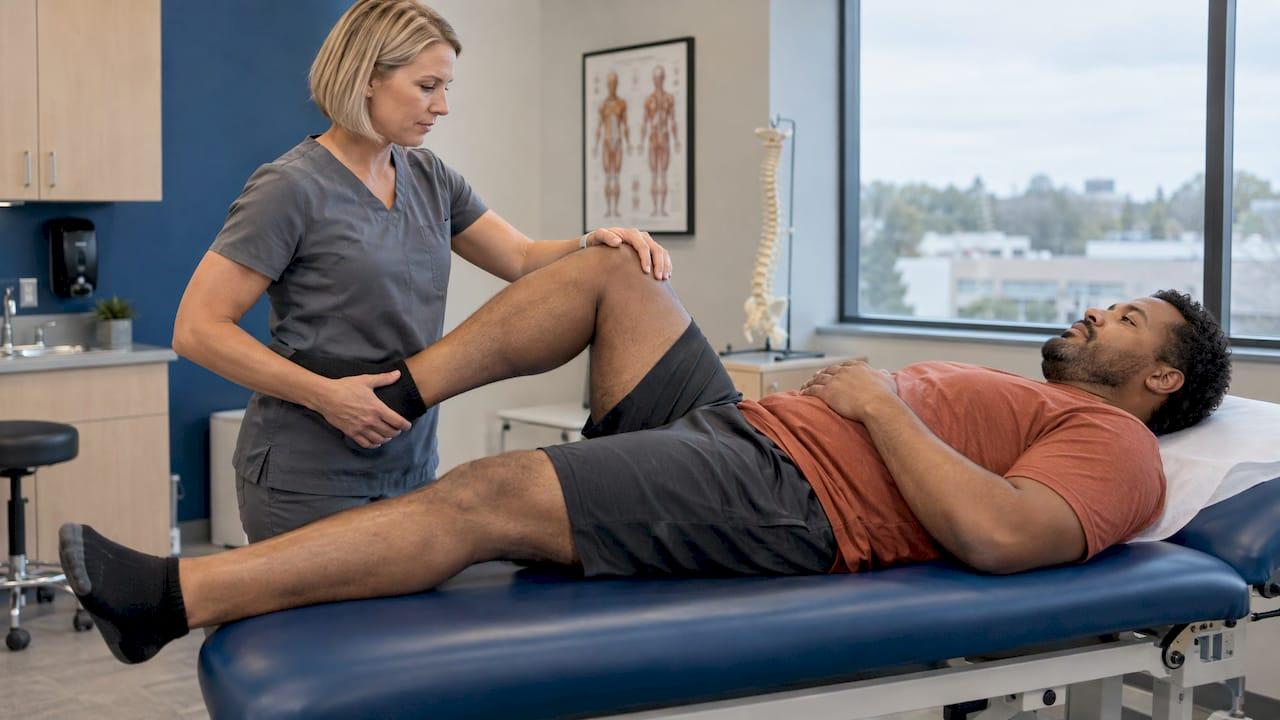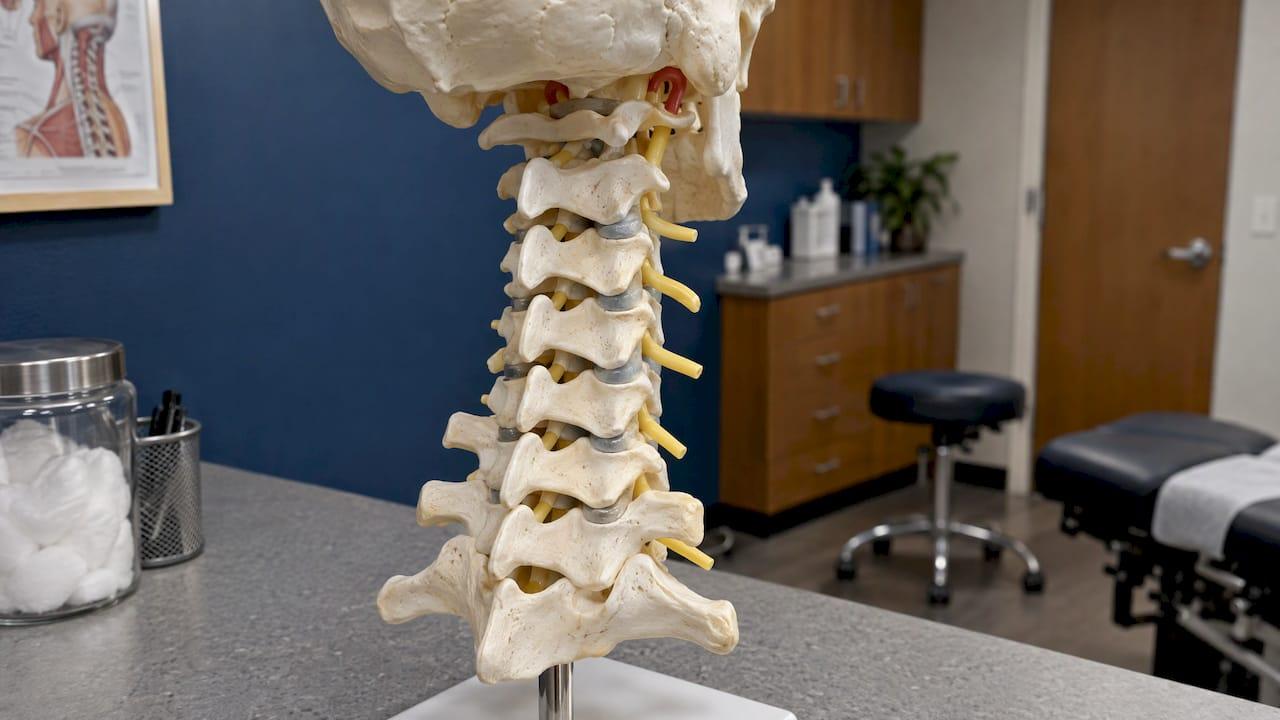
Cervical facet pain is neck pain that comes from the small paired joints at the back of your cervical spine. It usually feels dull and achy, sits in the neck, and often gets worse when you tilt your head back or turn it. It can also reach the base of the skull and the top of the shoulder. If it has lasted more than a couple of weeks, it deserves a proper evaluation. This guide explains what the pain feels like, how it differs from disc pain, what usually helps, and how our NUCCA team approaches it.
TL;DR
- Facet joints are the small joints at the back of each neck vertebra. When they become irritated, worn or injured, they can cause neck pain, shoulder pain and headaches. Doctors may call this cervical facet syndrome.
- Facet pain tends to stay in the neck and the top of the shoulder. Pain that travels farther down the arm, or comes with numbness or weakness, points toward a disc or nerve problem and needs a medical exam.
- First-line care in the research centers on movement: focused exercise, graded activity and range-of-motion work. Heat, gentle stretching and short-term pain relievers are common first steps.
- If neck pain lasts more than two weeks, see a professional. At Johnson Spinal Care, we start with a thorough exam and imaging before any correction.
Table of Contents
- Where the cervical facet joints are and what they do
- What cervical facet pain feels like
- What causes facet joint neck pain
- Facet pain vs. disc pain: how to tell the difference
- How cervical facet pain is evaluated
- What helps cervical facet pain
- Where NUCCA fits
- Our perspective on facet-related neck pain
- When to get your neck checked
- Book a NUCCA evaluation near you
- FAQ
- Sources
Where the cervical facet joints are and what they do
Your neck has seven cervical vertebrae stacked from the base of the skull down to the shoulders. Between each pair of vertebrae, you have a disc at the front and two facet joints at the back, one on each side. The facet joints are also called zygapophyseal joints. They guide and limit how far your neck can bend, rotate and extend.
According to Medscape’s clinical reference, these are synovial joints with fibrous capsules, inclined at about 45° from the horizontal plane. A capsule is rich in tiny nerve endings, which is why an irritated joint can hurt so much. Each joint is a small, slippery hinge, and when it is stressed, inflamed or worn, it signals pain.
The same source describes cervical facet syndrome as axial pain, meaning pain along the spine itself, that is presumably tied to the posterior elements of the cervical spine. An academic summary from Albert Einstein College of Medicine adds that the joints can generate neck pain or headaches, typically through degenerative changes.
So cervical facet pain, cervical facet syndrome and facet joint neck pain all describe the same idea: the joints themselves are a source of your symptoms.
What cervical facet pain feels like
Most people describe a deep, dull ache rather than a sharp, electric pain. It often sits to one side of the neck and gets worse with certain positions. Typical patterns include:
- Stiffness and soreness when you look over your shoulder to back up the car
- Pain when you tip your head back to look up or drink from a glass
- Aching after long stretches at a desk or screen
- Morning stiffness that eases as you move
- A headache that starts at the base of the skull and may wrap toward the head
The level of the spine matters. Per the Medscape referral map, facet joints at different levels send pain to predictable areas:
| Facet level | Where pain is commonly felt |
|---|---|
| C2-C3 | Back of the upper neck and head |
| C3-C4 | Side and back of the neck |
| C4-C5 | Middle and lower neck, top of the shoulder |
| C5-C6 | Middle and lower neck, top and outer shoulder |
| C6-C7 | Top and outer shoulder, down toward the lower edge of the shoulder blade |
This is why a stiff, aching upper neck can come with a headache, and why a lower neck problem can feel like shoulder pain. If you want to understand the headache side of this, our article on chronic daily headaches and the neck walks through the connection.
What causes facet joint neck pain
Facet joints can become painful for a few common reasons.
Wear and tear. Over the years, joint cartilage thins and the joints can become arthritic. This is sometimes called cervical spondylosis or facet arthrosis. It is common with age, and the Einstein summary notes that degenerative change is the typical cause.
Injury. Whiplash and other sudden neck movements can overload the joint capsules. A 2025 review in PubMed Central lists facet joints among the structures involved in neck pain after trauma. If you are recovering from a crash, our page on whiplash treatment in Apple Valley explains what an exam involves.
Sustained posture. Hours with your head forward and your chin poked out puts constant load on the back of the neck. Think of your head as a bowling ball balanced on a stack of small joints. The farther it drifts in front of your shoulders, the harder the back of the neck works to hold it. Our guide to desk neck pain covers ergonomics in more detail, and the one on neck pain when driving does the same for the car.
Sleep position. A pillow that is too high or too flat, or sleeping on your stomach with your head turned, can keep the joints in a strained position for hours. If you wake up sore, see what your body is telling you about neck pain after sleeping.

Facet pain vs. disc pain: how to tell the difference
People often ask whether their pain is a facet problem or a disc problem, including degenerative disc changes. The two can overlap, and only a clinician can sort them out, but the patterns differ.
The 2025 review says facet-mediated pain is typically axial and rarely spreads past the shoulders. It also says that radiation beyond the shoulder may point to a herniated cervical disc or symptomatic spinal stenosis.
| Feature | More typical of facet pain | More typical of disc or nerve involvement |
|---|---|---|
| Location | Neck, top of shoulder, base of skull | Can travel into the arm or hand |
| Feel | Dull, achy, stiff | Sharp, burning or electric, sometimes with tingling |
| Movement | Worse with extension and rotation | Often changes with arm position or neck flexion |
| Neurological signs | Absent | Numbness or weakness may be present |
The same review lists four features that raise the suspicion of facet-mediated pain: axial neck pain that rarely goes past the shoulders, pain when a clinician presses over the joints, pain with limited extension, side bending and rotation, and no neurological symptoms.
Treat this table as a guide for the conversation with your provider, not as a self-diagnosis. Numbness, tingling, weakness in an arm or hand, trouble with balance or walking, or loss of bladder or bowel control needs prompt medical attention.
How cervical facet pain is evaluated
The 2025 review explains that doctors diagnose cervical facet pain from your history, a physical examination and, in some cases, a diagnostic block of the small medial branch nerves that supply the painful joints. That review says imaging adds no diagnostic value for the facet pain itself, though it may be used to plan procedures. Imaging still has a role in a full workup, because it helps rule out fractures, instability or other structural problems, and in our practice it helps us measure the alignment of the upper neck.
A good exam for neck pain typically includes:
- Your story. When the pain started, what makes it better or worse, any past injuries, crashes, falls or concussions.
- Movement testing. How far you can turn, bend and extend your neck, and where it hurts.
- Hands-on palpation. Pressing over the joints and neck muscles to find tender segments.
- A neurological screen. Strength, sensation and reflexes in the arms.
- Imaging when it is warranted. To see the structure of the spine and rule out other causes.
Steven Cohen and colleagues, writing in Nature Reviews Rheumatology, note that diagnostic nerve blocks play more of a prognostic than a purely diagnostic role. That tells you the field itself is still refining how best to pinpoint the painful joint, which is one more reason a careful, individualized evaluation matters.
What helps cervical facet pain
Start with movement and simple measures
The 2025 review describes first-line therapy as focused exercise, graded activity and range-of-motion training. The 2021 consensus practice guidelines describe conservative care as typically including pain and anti-inflammatory medication, physiotherapy, heat or ice, massage, TENS, traction and spinal mobilization.
Harvard Health says a doctor might suggest rest, ice, heat, over-the-counter pain relievers and avoiding quick movements. A foam collar worn for a short time can rest the neck muscles. Stretching and strengthening are common ways to restore function.
Is heat good for facet joint pain?
For stiffness and soreness, yes, heat is a common and reasonable first step. Johns Hopkins Medicine states that stiffness and soreness alone are treated with heat or ice and a gentle stretching program. Many people find 15 to 20 minutes of warmth, followed by slow, comfortable range-of-motion movements, takes the edge off. Ice can help after a flare or a strain. Use whichever your neck prefers, and stop if the pain increases.
Daily habits that take load off the joints
- Raise your screen to eye level so your chin is not jutting forward.
- Take a movement break every 30 to 45 minutes.
- Sleep on your back or side with a pillow that keeps your neck in line with your spine, not bent up or down.
- Avoid long stretches with your head tipped back, such as painting a ceiling.
- Check how you hold your phone and try bringing it up instead of looking down.
When pain persists
For pain that does not settle, medical teams sometimes consider procedures aimed at the medial branch nerves. Cohen and colleagues report that radiofrequency denervation gives some benefit for up to a year in roughly 60 percent of people with facet-related pain. A 2021 randomized trial from Maastricht University found no significant difference at 6 months between radiofrequency plus an anesthetic and the anesthetic alone, though the time to end of treatment success was longer in the radiofrequency group.
The 2021 guidelines recommend a 6-week trial of conservative management before prognostic facet blocks for people with at least 3 months of neck pain. That is a decision for you and your physician or pain specialist. It also tells you that a well-run course of non-invasive care is a normal, expected first stage.
Where NUCCA fits
Our clinics are built around the upper cervical spine, the atlas (C1) and axis (C2) at the top of the neck. That region carries the weight of your head, allows much of your neck’s rotation, and sits right where the head meets the spine. The facet joints at C2-C3 refer pain to the upper neck and head, so the upper neck is often involved when someone has stiffness together with headaches.
Here is how care works for us:
- Measurement and imaging first. We evaluate your alignment before any correction, using a comprehensive exam and advanced imaging.
- A precise, low-force correction. A NUCCA adjustment involves no twisting, popping or cracking of the neck.
- A plan aimed at holding alignment. The goal is for the correction to hold, so that patients need fewer visits over time.
- A team approach. We are happy to work alongside your medical doctor, physical therapist or dentist, and we tell you when something should be seen by a medical provider first.
We do not claim that NUCCA replaces a medical diagnosis or that it is right for every neck. Our job at the first visit is to find out whether the upper neck is contributing to your symptoms and to recommend a plan that fits you.
Our perspective on facet-related neck pain
We see many people who arrive having already tried rest, medication, massage or therapy. Their neck still aches, turning the head still catches, and the headaches keep coming back. Often, they are tired of being told it is just wear and tear or just stress.
Our view is that the upper neck deserves a close look. Small changes in how the atlas sits under the skull can change how the whole neck loads, and the joints below have to compensate. That is why we measure first. We want to see how your neck is aligned before we touch it.
The correction itself is gentle. It is light, specific and calculated from your images, without twisting or cracking. For a person with a sore, irritable neck, that matters a great deal. Many of our patients come to us nervous about having their neck handled, and a low-force approach lets them relax.
We have practiced since 1986 as the first NUCCA clinic in Minnesota, and our five NUCCA-certified doctors care for people from children to seniors across three Twin Cities clinics. Whatever you decide, we encourage you to have ongoing neck pain examined, and to bring any numbness, weakness or sudden severe symptoms to your medical doctor right away.
Johnson Spinal Care Clinical Team
When to get your neck checked
Harvard Health suggests seeking professional help if neck pain lasts more than two weeks. It lists arthritis, bone spurs, ruptured discs, fractures, scoliosis and old whiplash injuries among the more serious causes. A primary care physician or orthopedic specialist is a good place to start for a diagnosis.
See a medical doctor promptly, or go to urgent care, if you have:
- Neck pain after a significant fall, crash or blow to the head
- Numbness, tingling or weakness in your arms or hands
- Fever with a stiff neck, or a sudden, severe headache unlike any you have had
- Trouble walking, loss of balance, or loss of bladder or bowel control
- Pain that is getting steadily worse or wakes you every night
If your exam is clear of those red flags and the ache keeps coming back, a careful upper cervical evaluation is a reasonable next step. You do not have to choose between your medical team and ours.
Book a NUCCA evaluation near you
If your neck pain, stiffness or headaches keep returning, we would like to help you find out whether the upper cervical spine is part of the picture. Your first visit centers on a thorough examination and imaging, then a plan built around you. You can read more about NUCCA upper cervical chiropractic care or learn what NUCCA chiropractic is.

We see patients at our Apple Valley clinic, our Savage clinic (see our page on neck pain care in Savage) and our White Bear Lake clinic in Vadnais Heights. Patients rate us 4.9 stars across 394 Google reviews.
FAQ
What is the difference between cervical facet pain and cervical facet syndrome?
They describe the same problem. Cervical facet pain is the symptom, and cervical facet syndrome is the name clinicians use when the facet joints of the neck are the presumed source of neck pain or headaches. The pain is usually dull and achy, and it often shows up in the neck, shoulder or base of the skull.
Can a chiropractor help with facet joint neck pain?
A chiropractor can examine your neck, look at how your spine is aligned and moves, and recommend a plan. At Johnson Spinal Care, we use measurement and imaging first, then a low-force NUCCA correction with no twisting or cracking. We also tell you if your symptoms call for a medical exam before care.
How do I know if my neck pain is a facet problem or a disc problem?
Facet pain tends to stay in the neck and top of the shoulder, and it is often worse when you extend or rotate your neck. Pain, numbness or weakness that travels down the arm suggests a disc or nerve issue. Only an in-person exam can tell them apart, so get any arm symptoms checked promptly.
Is heat good for facet joint pain?
Heat is a common first step for stiffness and soreness, and Johns Hopkins Medicine lists heat or ice with gentle stretching for these symptoms. Try 15 to 20 minutes of warmth, then gentle movement. If the pain is severe, is getting worse, or lasts more than two weeks, have it evaluated.
Sources
- Cervical Facet Syndrome: Background, Etiology, Epidemiology (Medscape)
- Zygapophyseal (Facet) Pain Syndrome (Albert Einstein College of Medicine)
- Cervical facet pain: Degenerative alterations and treatment (PubMed Central, 2025)
- Consensus practice guidelines on interventions for cervical facet joint pain (PubMed Central, 2021)
- Facet joint pain: advances in patient selection and treatment (Nature Reviews Rheumatology, 2012)
- Efficacy and Long-term Effect of Radiofrequency Denervation (Maastricht University, 2021)
- Neck Pain (Harvard Health)
- Do habits cause your neck pain? (Harvard Health)